

Darwin's disease
The historiography of diagnosis of the past
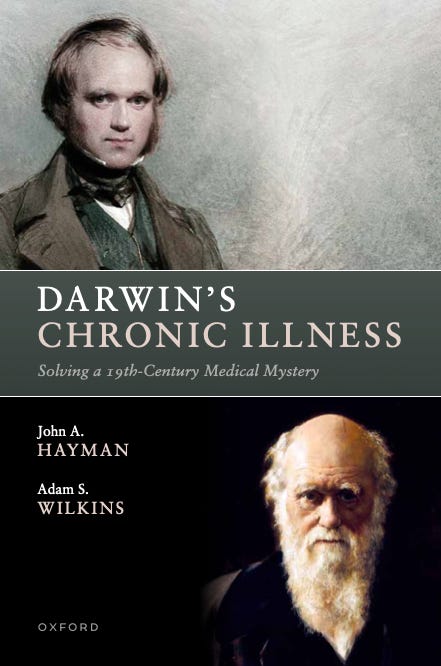
Darwin’s Disease
This is a draft only. I meant to say that when I pressed publish. It will be revised heavily for publication, so please do not quote it yet.
Wilkins, A. S., & Hayman, J. A. (2026). Darwin’s Chronic Illness: Solving a 19th-Century Medical Mystery. Oxford University Press; available for pre-order now, via OUP and Amazon, ahead of release in October 2026 (in the US) and January 2027 (in the UK).
John S. Wilkins, University of Melbourne1
In the middle of the last century, non-historians were keen to explain individuals and movements in terms of general processes. This gave rise to some good, and some fantastical, results. One of the latter was the attempt to psychoanalyse Luther, by psychoanalyst Erik Erikson in his Young Man Luther (1958). Luther, he said, was in crisis because he was “anal retentive”, a Freudian term no longer in use, one hopes. This “psychobiography”, as it was termed by commentators, showed the difficulties of analysing a historical figures through textual sources, when the analytical method used relies upon interaction between the subject and the analyst. For the same reason, and perhaps because of this mistaken approach by Erikson, noninteractional psychological assessments based upon a priori categories are rejected by the American Psychological Association even today.2 This is how not to do history, projecting ideas of the present into the past. The book under review, however, avoids these errors.
History is an empirical science more than most humanist disciplines. Gone are the days of simple single cause explanations based upon grand historical schemes. If Caesar crossed the Rubicon because of an upset stomach, we shall never know. But the use of modern methods to analyse the past is not barred for good history, and this book exemplifies that fact.
In the flurry of Darwin scholarship since the first half centenary of the publication of the Origin of Species in 1909, scholars have pored over his correspondence, memoirs of those who knew him, and such other material left since his death, in order to discover why he spent so much of his productive life in a state of illness. There are many proposed diagnoses: Chagas’ disease from South American parasites, social and political anxieties for the revolutionary nature of his theories, religious conflicts, Ménière’s, and a host of infections, toxins, allergies and yes, psychological issues (Buchanan 2021 reviews the history of these attempts).
The authors review these many (20 plus!) hypotheses and their flaws and failures to explain all the symptoms reported. It is not until the sixth and seventh chapters that the authors introduce their own diagnosis and the argument for it, and while I do not wish to give spoilers, Hayman has published aspects of the maternal mitochondrial variant hypothesis in 2009 in BMJ, and in his PhD in 2014, as well as a listing of past incomplete hypotheses in 2022 in Cureus.3 Hayman’s coauthor, well-regarded developmental geneticist Adam S. Wilkins (Humboldt-Universität), is evident in the technical description of the nature and inheritance of mtDNA, or mitochondrial genes throughout, for those who do not have a biology degree. Some may complain about technical overkill, just as publishers advise scientists to avoid mathematical equations, but there is a nice consequence of their hypothesis: mitochondrial variations of this kind may be responsible for a host of “syndromes” such as chronic fatigue, so this is generalisable and informative as well as explanatory of Darwin’s malaise.
The basic mechanism of their hypothesis is that the cellular organelle, the mitochondria, which are always4 inherited matrilinearly, have their own genes, and mutations in these may have extensive knock-on effects in development, manifesting as symptoms of a nonspecific nature. Mitochondria are ancient inclusions into eukaryotic cells, through a process known as endosymbiosis. They primarily generate the energy molecules of body cells, ATP. Suppression of some genes, or even one gene, in the mitochondrial genome can lead to partial loss of function. MELAS (Mitochondrial Encephalomyopathy, Lactic acidosis, and Stroke-like episodes) matches many of the Darwin/Wedgwood pathologies, including Chronic Vomiting Syndrome, which the authors diagnose of Darwin.
I would have liked more of a discussion on the nature of “diseases” and “pathological conditions” through the nineteenth century to today. What the modern medical profession and the medical profession of Darwin’s day meant by these terms not only differ, but radically so. The sociopolitical aspects of illness are, since the 1970s, a major topic in the philosophy, history and sociology of medicine, and some guidelines for the reader could have helped.
The book is meant for non-specialists (in Darwin studies) and medical non-specialists (in inherited diseases via mitochondria). It seems to be a mixture not mutually supportive. Technical aspects of mitochondrial function and malfunction compete with source material history and diagnosis. That said, I cannot easily see how else it might have been written. Medical diagnosis is hard, and this is a lovely detective story, among other things.
Finally, I have to say that what convinced me of the viability of this approach is the family inheritance aspects, which are generally not dealt with in the earlier attempts. Without access to Darwin’s own mtDNA, it nevertheless remains a testable hypothesis in terms of the genetics of a family tree, so if we could sample mtDNA from Darwin and Wedgwood descendants we could, so far as is possible in these matters, confirm it. Many of the documentary sources they cite show that Charles was not the only family member with mysterious malaises. Whether this is worth the knowing, as classicist Theodore Mommsen said of the origin of the Etruscans,5 is up to historians, and whether it is capable of being known, is up to the scientists. I think both.
Previous “solutions” have affirmed they are the last word on the topic, and have failed to be.6 One may reasonably doubt whether this is either, but that problem is inevitable in any science. However, this hypothesis is comprehensive in its explanatory power for the symptoms, and is not merely another impressionist diagnosis. It converges upon the truth far better than prior attempts to explain Darwin’s disease.
References
Buchanan, Roderick D. “Syndrome Du Jour: The Historiography and Moral Implications of Diagnosing Darwin.” Studies in History and Philosophy of Science Part A 90 (December 2021): 86–101. https://doi.org/10.1016/j.shpsa.2021.09.006.
Hayman, John A. “Darwin’s Illness Revisited.” Feature. BMJ 339 (December 2009): b4968. https://doi.org/10.1136/bmj.b4968.
Hayman, John A. “Diagnosing Darwin: Charles Darwin’s ‘Mystery Illness.’” PhD, University of Melbourne, 2014. https://hdl.handle.net/11343/48439.
Hayman, John, and Josef Finsterer. “Diagnoses for Charles Darwin’s Illness: A Wealth of Inaccurate Differential Diagnoses.” Cureus 14, no. 11 (2022): e32065. https://doi.org/10.7759/cureus.32065.
Mommsen, T. (1862). The History of Rome (Vol. 1). R. Bentley.
Orrego, Fernando, and Carlos Quintana. “Darwin’s Illness: A Final Diagnosis.” Notes and Records: The Royal Society Journal of the History of Science 61, no. 1 (2006): 23–29. https://doi.org/10.1098/rsnr.2006.0160.
Vissing, John. “Paternal Comeback in Mitochondrial DNA Inheritance.” Proceedings of the National Academy of Sciences 116, no. 5 (2019): 1475–76. https://doi.org/10.1073/pnas.1821192116.
Notes
1 Email john.wilkins@unimelb.edu.au
2 The APA Standards 9.01b.
3 J. A. Hayman 2009, 2014; J. Hayman and Finsterer 2022.
4 Well, mostly. Some paternal mitochondria can find their way into progeny, but the paternal contribution doesn’t last for long, somatically or genealogically. The question is still debated (Vissing 2019).
5 History of Rome Volume I, chapter IX.
6 Orrego and Quintana 2006, promoting a Crohns’ disease diagnosis.